At 45°N latitude — roughly the latitude of southern Ontario — the winter solstice delivers fewer than 9 hours of daylight. At 52°N, near Edmonton or Saskatoon, that figure drops closer to 7.5 hours. Even on a clear day, the low solar angle in December reduces the intensity of incoming radiation, and overcast days common to much of the country further reduce the daily light integral (DLI) reaching crops inside a greenhouse.
For leafy crops — lettuce, spinach, arugula, kale, and similar species — the relationship between DLI and growth rate is fairly well understood. Below approximately 6–8 mol/m²/day, growth rates slow substantially. Maintaining commercially or practically useful harvest cycles through winter typically requires supplemental lighting to reach and sustain DLI levels in the 12–17 mol/m²/day range, depending on crop species and target harvest time.
Daily Light Integral and Why It Matters
DLI represents the total amount of photosynthetically active radiation (PAR) received over a full day, expressed in moles of photons per square metre per day (mol/m²/day). It accounts for both light intensity (photosynthetic photon flux density, or PPFD, measured in µmol/m²/s) and duration.
A fixture delivering 200 µmol/m²/s for 16 hours provides a DLI of approximately 11.5 mol/m²/day. Adding the natural DLI on a typical January day in Ontario — often 3–5 mol/m²/day on clear days, less on overcast days — brings the combined DLI into a range where most lettuce varieties maintain adequate growth rates.
Target DLI by Crop
Lettuce varieties generally perform well in the 12–17 mol/m²/day range. Spinach and Asian greens can tolerate somewhat lower DLI, while basil and herbs typically require 15–20 mol/m²/day for productive yields. These ranges are from published controlled-environment agriculture literature, not general estimates.
LED vs. HPS: The Current State of the Technology
High-pressure sodium (HPS) fixtures have been the industry standard in commercial greenhouse supplemental lighting for decades. They deliver high output with a warm spectral profile concentrated in orange and red wavelengths. HPS fixtures are mature technology with well-understood maintenance requirements, and their waste heat can contribute meaningfully to greenhouse temperature in cold climates — a characteristic that becomes an advantage in winter and a disadvantage in summer.
LED fixtures have displaced HPS in many new installations over the past decade, primarily on the basis of energy efficiency. Modern full-spectrum greenhouse LEDs achieve efficacy figures in the range of 2.5–3.5 µmol/J, compared to approximately 1.5–1.9 µmol/J for HPS. For a small-scale operation running lights 14–16 hours per day through a 12-week Canadian winter, the difference in electricity consumption is significant at current electricity rates.
The trade-off is that LED fixtures produce less waste heat. In a heated greenhouse, this difference is absorbed by the heating system with no net effect on energy balance. In a passively heated or minimally heated structure, however, the additional radiant heat from HPS fixtures may reduce supplemental heating requirements enough to narrow the overall energy cost difference between the two technologies.
Photoperiod Management and Bolting Risk
Photoperiod — the number of hours of light per day — is distinct from total light intensity (DLI). Many leafy crops are day-length sensitive, and exposure to long photoperiods (typically above 16 hours) can trigger bolting responses in species such as lettuce, arugula, and spinach. Bolting makes leaves bitter and reduces the edible harvest window.
For DLI accumulation through supplemental lighting, most practical approaches in winter extend the day rather than increase intensity, because extending from 9 natural hours to 14–16 hours with moderate-intensity fixtures is more energy-efficient than delivering the same DLI in fewer hours at higher intensity. However, the 16-hour threshold for many lettuce varieties means that extension beyond that point carries increasing bolting risk.
An alternative approach used in commercial operations is cyclic or interrupted lighting — periods of light and dark within the night period rather than continuous extension. Research from controlled-environment agriculture institutions suggests that some crops respond to total DLI accumulated over a 24-hour period more than to photoperiod specifically, though the relationship is crop-variety dependent and not universal.
Fixture Placement and Light Distribution
Canopy-level PPFD uniformity affects yield consistency across a growing area. Fixtures mounted too high reduce intensity but improve uniformity; fixtures too close increase intensity in the zone directly below but create hot spots and shadows in surrounding areas. For row-style growing in small greenhouses, fixtures hung 30–60cm above canopy height and spaced to provide consistent overlap are a standard approach.
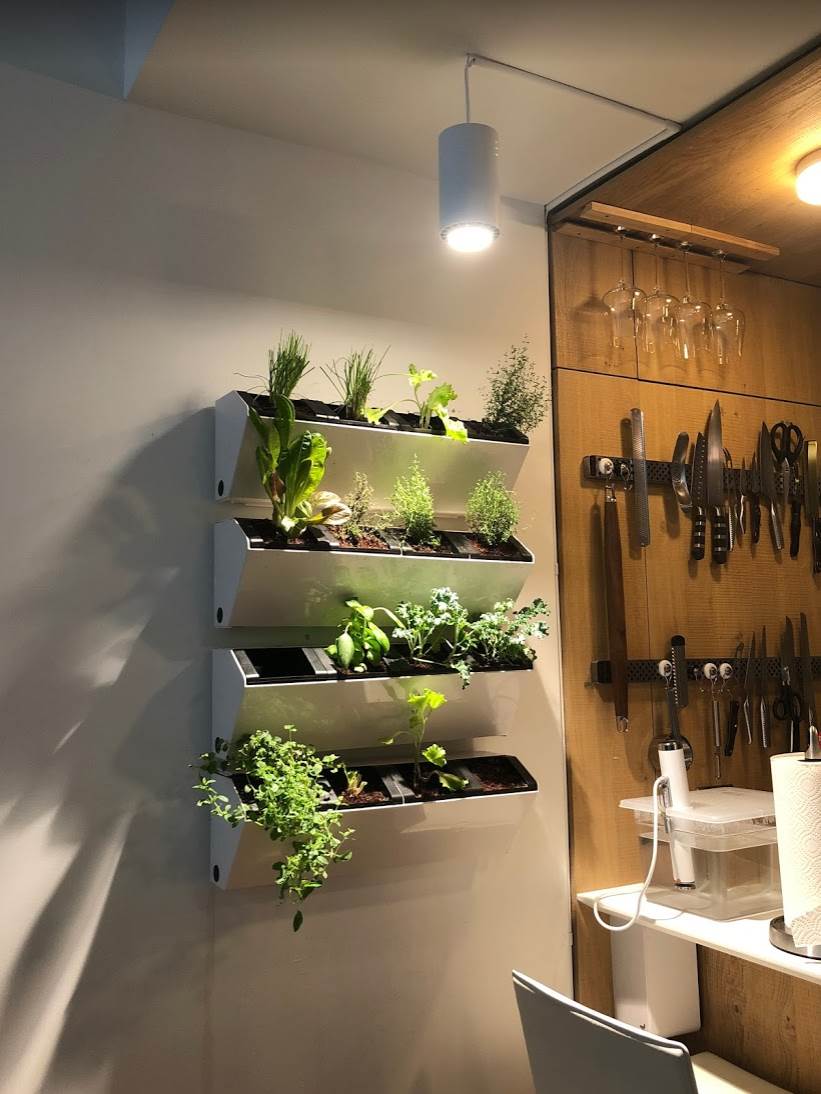
Vertical growing systems — used in some small Canadian operations for maximizing space — require interlayer lighting where fixtures illuminate each growing tier from the side or below. LED strips or bar lights are better suited to this configuration than HPS, due to their lower heat output and form factor.

Vertical Growing
VertiCrop vertical growing system. Photo: Wikimedia Commons / CC BY-SA
Practical Guidance for Small Operations
For a backyard or small commercial greenhouse in Canada targeting leafy crop production from November through February, a reasonable starting point is supplemental lighting that can deliver 150–250 µmol/m²/s at canopy level for 14–16 hours per day. Combined with typical January DLI at 45–52°N, this typically achieves cumulative DLI levels sufficient for steady lettuce and spinach growth.
Energy consumption at these parameters is not negligible. A 200W LED fixture running 15 hours/day uses 3 kWh/day. For a 10m² growing area requiring 4–6 fixtures, monthly electricity use from lighting alone ranges from 360 to 540 kWh. At Ontario Time-of-Use rates or Alberta flat electricity rates, this is a material operating cost that should be incorporated into any planning for a small commercial operation.
| Fixture Type | Typical Efficacy | Heat Output | Notes |
|---|---|---|---|
| HPS 600W | ~1.6 µmol/J | High | Adds measurable heat; mature technology |
| Full-spectrum LED bar | 2.5–3.2 µmol/J | Low–moderate | Current industry standard in new installations |
| T5 fluorescent | ~0.9–1.1 µmol/J | Low | Adequate for propagation and seedlings; limited for full-cycle winter production |
Further Reading
The University of Guelph's Controlled Environment Systems Research Facility has published extensively on DLI requirements for greenhouse vegetables in Canadian conditions. OMAFRA's crop management resources for greenhouse growers include lighting recommendations relevant to Ontario operations.