
Humidity management is the least discussed of the three main variables in winter greenhouse production, yet it is frequently the one that causes the most direct crop loss. In a tightly sealed, well-insulated structure, the transpiration from growing plants and evaporation from growing media, water surfaces, and wet floors accumulates continuously. With little or no ventilation possible during cold spells — opening vents or doors when outside temperatures are −15°C removes heat faster than it can be replaced in a small structure — relative humidity (RH) can rise to levels that favour fungal pathogens.
The key pathogens for leafy crops in high-humidity conditions are Botrytis cinerea (grey mould), downy mildew (various Peronospora species on different crops), and Pythium species in hydroponic or waterlogged soil systems. Each has somewhat different conditions for outbreak, but all are associated with sustained periods of high humidity, condensation on leaf surfaces, and poor air circulation.
Why Humidity Rises in Sealed Winter Structures
Plants transpire water vapour continuously during the light period and, to a lesser extent, during dark periods. In a greenhouse containing a meaningful growing area, cumulative transpiration can add substantial moisture to the air each day. In summer, ventilation flushes this moisture outside. In winter, when ventilation is minimized, the moisture accumulates.
The relationship between temperature and humidity is important here. Warm air holds more water vapour than cold air. When warm, humid air inside a greenhouse contacts cold glazing surfaces, it can drop below its dew point, and condensation forms on the glazing and on any cold structure or plant surfaces nearby. Water droplets on leaves create ideal infection sites for Botrytis and downy mildew.
Temperature gradients within the greenhouse — cold spots near glazing, warmer air near heaters — exacerbate the condensation problem. Structures with single-layer glazing on cold nights develop pronounced cold surfaces even when the air temperature near the centre of the space is adequately warm.
Measuring and Monitoring Relative Humidity
A basic digital hygrometer with min/max memory is sufficient for monitoring humidity in a small greenhouse. Placing sensors at canopy level rather than hanging them at eye height gives readings more relevant to where disease risk is highest. In larger structures, multiple sensors at different locations help identify cold spots and areas with restricted air movement.
Target RH for leafy crop production in a winter greenhouse is commonly given as 60–80%. Below 60%, plant stress from excessive transpiration may occur; above 80% sustained for extended periods, fungal disease pressure increases meaningfully. The goal in winter is usually to stay below 85% rather than to reach a precise target, since some humidity fluctuation is inevitable.
Vapour Pressure Deficit (VPD)
Commercial operations often use vapour pressure deficit (VPD) rather than RH as the primary management metric. VPD accounts for temperature in the relationship between actual humidity and the maximum the air can hold. A target VPD for leafy crops is typically in the 0.4–1.0 kPa range. For small operations without environmental controllers, RH monitoring is a practical proxy.
Passive Approaches to Humidity Reduction
The simplest intervention is controlled minimal ventilation — opening a small vent or door briefly during the warmest part of the day when outside temperatures are relatively less severe. Even a short ventilation period of 5–10 minutes can flush accumulated moisture and reduce RH noticeably, at the cost of some heat loss. In structures with supplemental heating, this cost is manageable.
Improving internal air circulation without opening the structure reduces the temperature gradients that cause condensation. A small oscillating fan or two positioned to move air across the crop canopy and over glazing surfaces keeps the air mixed. Moving air also carries moisture away from leaf surfaces more effectively, reducing the time leaves remain wet after condensation or overhead irrigation events.
Avoiding overhead irrigation during the dark period reduces moisture input at the most vulnerable time — when transpiration-driven humidity removal is lowest and temperatures have dropped. Bottom or sub-irrigation systems (including most hydroponic methods) add moisture only to the root zone and reduce canopy wetting substantially.
Active Dehumidification
Refrigerant-based dehumidifiers can be used in sealed greenhouses to actively remove moisture. They work by cooling air below the dew point over refrigerant coils, collecting condensed water, and returning drier (and slightly warmed) air to the space. In a winter greenhouse, the heat output from the dehumidifier contributes to overall heating, which partially offsets the electricity cost of running the unit.
Sizing a dehumidifier for a greenhouse requires estimating the moisture load — the amount of water vapour entering the air from plant transpiration and other sources per hour. In practice, small dehumidifier units rated for 20–40L/day are used in hobby and small commercial operations. Larger commercial structures use purpose-built agricultural dehumidifiers integrated with the HVAC system.
Hydroponic vs. Soil-Based Systems and Humidity
Hydroponic systems for leafy crops — nutrient film technique (NFT), deep water culture (DWC), and similar methods — expose large water surfaces directly to the greenhouse air. These water surfaces contribute to humidity load, particularly if the nutrient solution is at room temperature rather than cooled. Covering exposed water surfaces in reservoirs and return channels reduces evaporation.
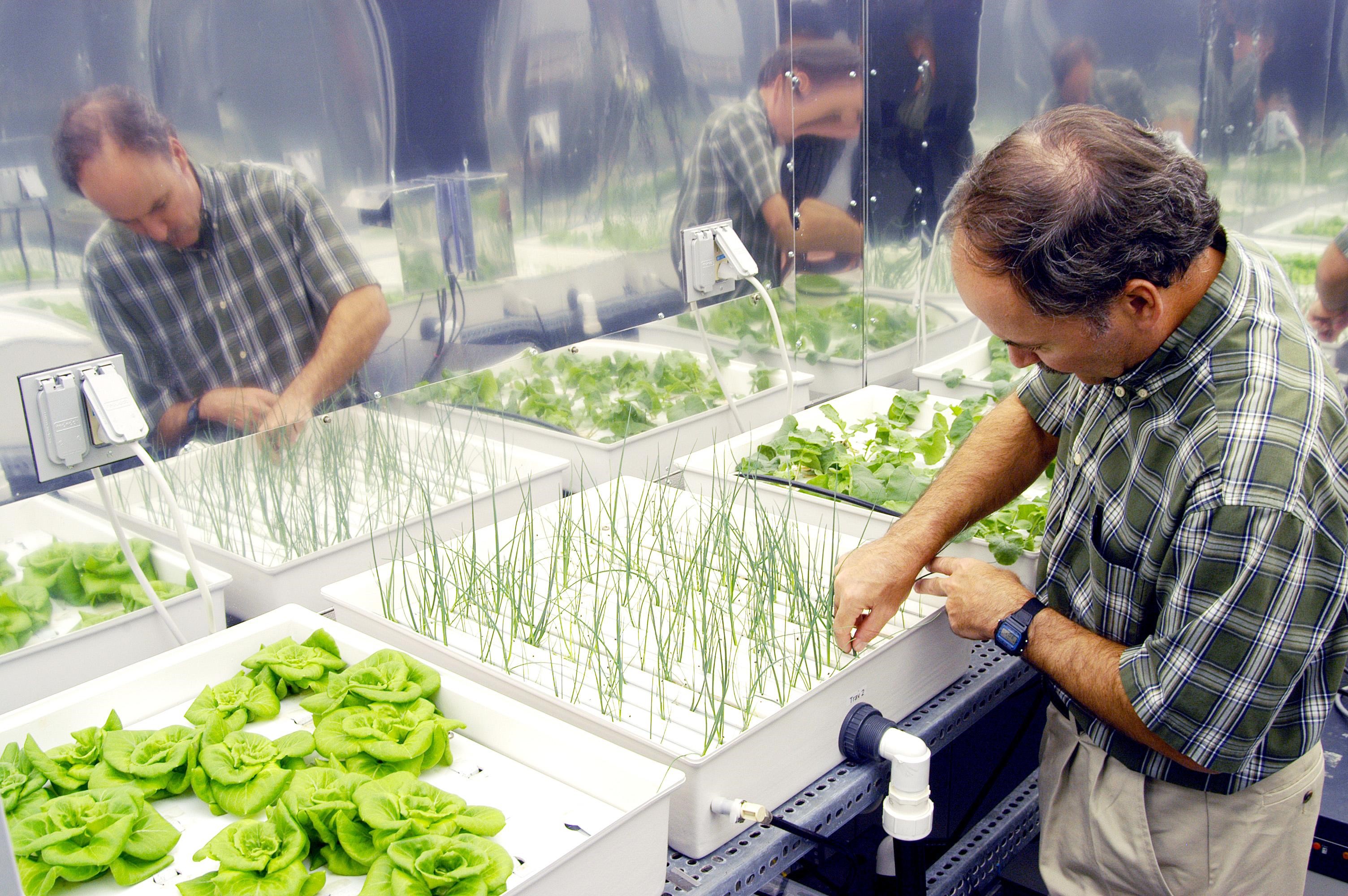
Hydroponic Research
Hydroponic growing research. Photo: Wikimedia Commons / Public Domain (NASA)
Soil or peat-based growing media in containers retains and gradually releases moisture between irrigation events. Overwatering in winter — a common error when growth rates slow and uptake decreases — leaves growing media saturated for extended periods, which both increases humidity load and creates conditions conducive to Pythium root rot in susceptible crops.
Crop Selection and Spacing as a Humidity Management Tool
Wider plant spacing reduces canopy density and allows air movement between plants, reducing the probability of sustained leaf wetness in the interior of a dense canopy. In winter, when growth rates are lower and harvest cycles extend, it is sometimes practical to grow at lower density than in summer, using the same floor area for a smaller number of plants with better individual air circulation.
Some crop species tolerate high humidity better than others. Mâche (corn salad), certain Asian brassicas, and kale are among the more humidity-tolerant options. Basil, by contrast, is highly susceptible to Botrytis in high-humidity conditions and is a poor choice for sealed winter production without active dehumidification.
Summary of Approaches
| Approach | Mechanism | Suitable For |
|---|---|---|
| Timed ventilation (daytime) | Flushes humid air with drier outside air | Structures with supplemental heat |
| Internal air circulation fan | Reduces cold spots, moves moisture off leaf surfaces | All sealed winter structures |
| Bottom/sub-irrigation only | Eliminates canopy wetting from overhead irrigation | Container and hydroponic systems |
| Refrigerant dehumidifier | Actively condenses and removes moisture | Tightly sealed structures, commercial operations |
| Reduced planting density | Improves air movement within canopy | All winter growing systems |